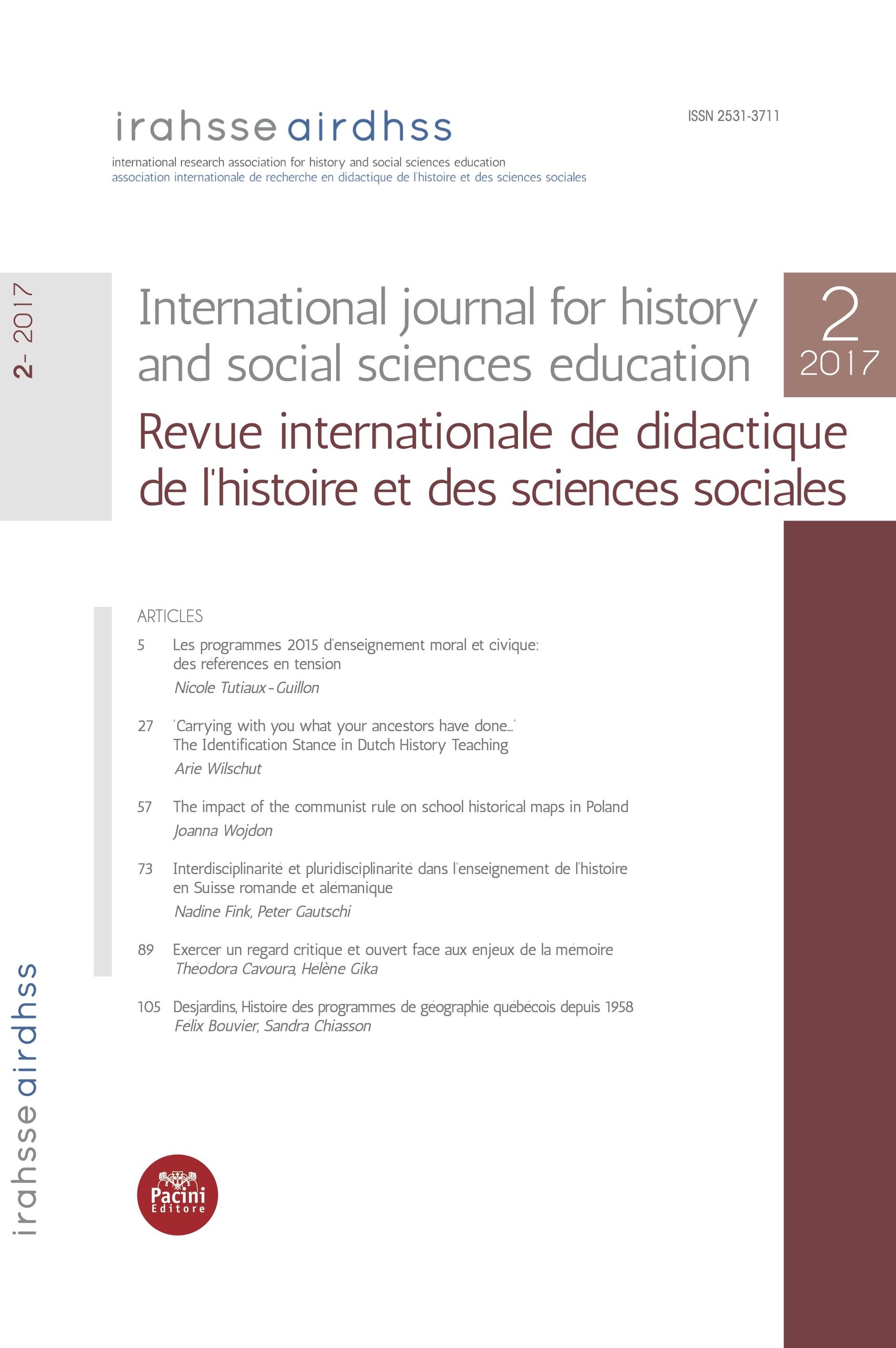
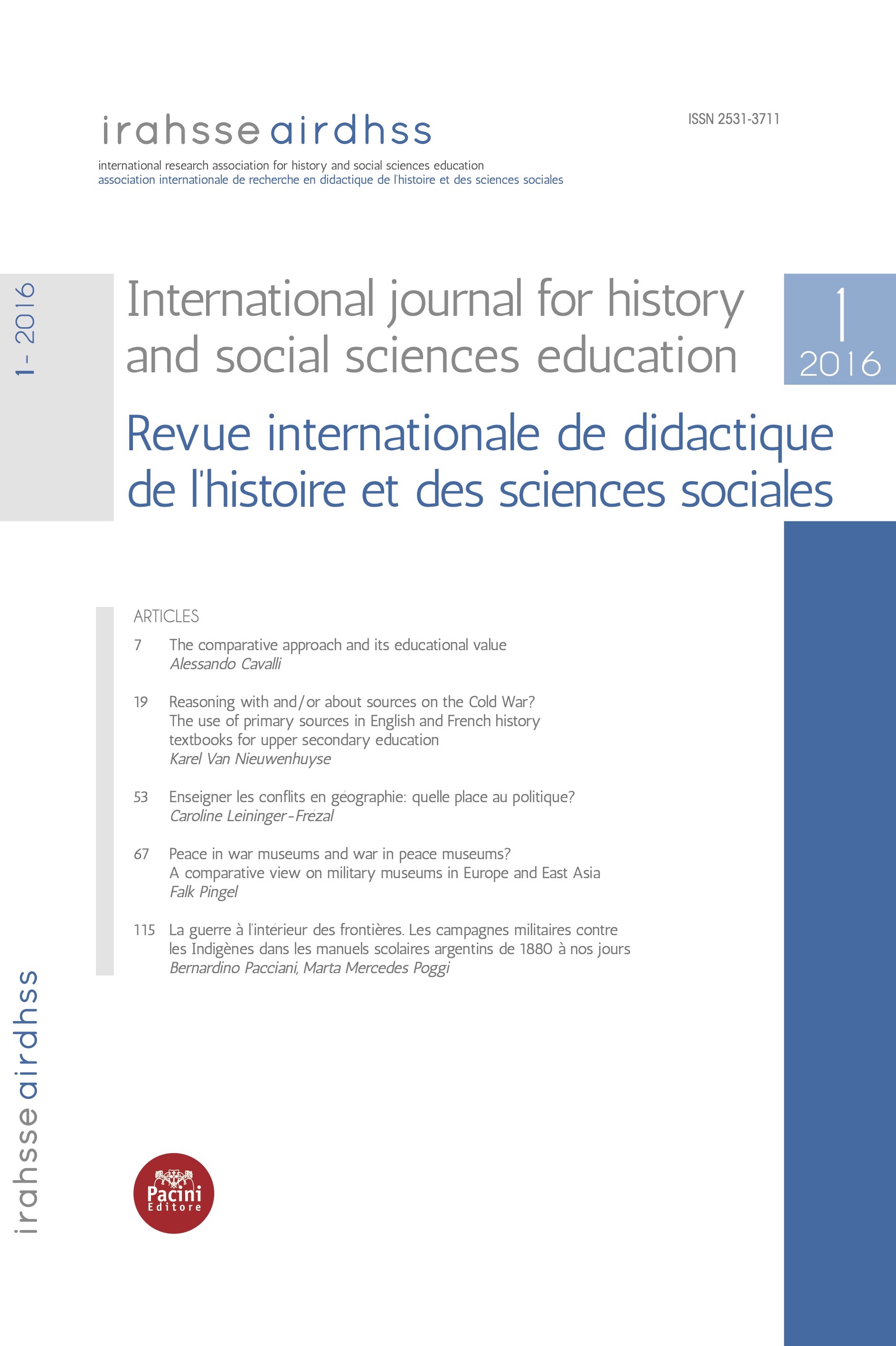
Journal
Journal profile
The International Journal of History and Social Sciences Education / Revue internationale pour l’enseignement de l’histoire et des sciences sociales is an international, bilingual (French–English), interdisciplinary, peer-reviewed scholarly journal. It is the journal of the International Research Association for History and Social Sciences Education (IRAHSSE/AIRDHSS) and is published by Les Presses de l’Université de Montréal. It continues the journal previously published by Pacini Editore. Its editorial leadership is based in Quebec and is supported by an international scientific committee reflecting the association’s geographical, linguistic and scholarly diversity.
It disseminates original research on the teaching, learning and social uses of history, geography and the social sciences, as well as citizenship education. It provides a forum for reflection on the construction, transmission and appropriation of knowledge in school and out-of-school settings, and on the educational, social, cultural and political issues involved.
Its distinctive interdisciplinary approach fosters dialogue between these disciplines, related fields and their various research traditions. It welcomes contributions examining their objects of study, methods, educational aims and respective contributions to understanding societies. Historical, historiographical and epistemological approaches are also welcome.
In keeping with the international mission of IRAHSSE/AIRDHSS, the journal encourages comparative and transnational research, as well as analyses conducted in diverse cultural, linguistic and educational contexts.
Contributions may address, among other topics, curricula and educational policies; historical, geographical and social thinking; teacher education; textbooks and educational resources; museums and public history; memory and heritage; citizenship education; colonial and postcolonial issues, including the decolonisation of knowledge; democracy and human rights; diversity, inclusion and living together; socially sensitive or controversial issues; and digital technologies in teaching and learning.
The journal publishes original theoretical, empirical or historiographical research articles, thematic collections coordinated by guest editors and, where appropriate, papers arising from IRAHSSE/AIRDHSS conferences. It also welcomes book reviews and critical essays that make a significant contribution to advancing knowledge in the field.
One regular issue is published each year, with occasional special issues. Ahead of each issue’s closing, articles are made available online as they are finalized following acceptance. All content is immediately available through open access, with no submission fees or article processing charges (APCs) for authors.
Submitting a manuscript
The International Journal of History and Social Sciences Education welcomes original manuscripts in French or English that have not previously been published and are not simultaneously under consideration by another journal or publisher.
Types of contributions
The journal accepts the following types of contributions:
- theoretical, historiographical and empirical articles;
- book reviews;
- critical essays.
These contributions may be published individually or brought together in thematic collections coordinated by guest editors. The journal also welcomes selected papers arising from academic conferences, either by invitation or in response to a call for papers.
Languages
Manuscripts may be submitted in French or English. Details of spelling conventions are provided in the style guidelines below.
Each manuscript must be accompanied by the following items in both French and English:
- a title;
- an abstract of no more than 200 words in each language;
- four to six keywords.
Manuscript preparation
Manuscripts must be anonymised for double-blind peer review. Authors must remove identifying information and present references to their own work in a way that preserves anonymity.
The following information must be provided for each author in a separate document:
- full name;
- institutional affiliation;
- email address;
- ORCID iD;
- a short biographical note (no more than 200 words).
The corresponding author must be clearly identified.
Length
Articles should be between 8,000 and 10,000 words, including references, notes and appendices.
Book reviews should not exceed 1,500 words.
Style guidelines
Manuscripts must follow the presentation, citation and referencing guidelines of the American Psychological Association (APA, 7th edition), adapted to French linguistic conventions for manuscripts written in French.
Manuscripts written in English must consistently use British spelling.
Manuscripts written in French must follow standard French language conventions. The revised spelling conventions introduced in 1990 are accepted but remain optional.
Authors are encouraged to use inclusive language consistent with their institution’s recommendations.
Authors are responsible for ensuring the clarity and linguistic quality of their text and, where necessary, having it language-edited before submission.
Tables and illustrations
Tables, graphs and illustrations must be numbered, accompanied by a title or caption, and inserted in the manuscript at the intended location. They must also be submitted as separate files: in an editable format for tables and graphs, and in .jpg or .tif format, with a minimum resolution of 600 dpi, for illustrations.
Authors are responsible for obtaining the necessary permissions to reproduce any copyright-protected material.
Review process
All manuscripts undergo a rigorous scholarly review process, in accordance with the procedures outlined below.
1 Initial editorial assessment
The editorial board assesses:
- the manuscript’s alignment with the journal’s aims;
- its overall scholarly quality;
- compliance with the author guidelines;
- compliance with ethical standards.
Manuscripts that do not meet these criteria may be rejected without being sent for external review.
2 Peer review
Manuscripts selected for external review, with the exception of book reviews, undergo double-blind peer review by at least two independent specialists in the field. This procedure also applies to articles submitted as part of thematic collections or arising from conferences.
Reviewers consider, in particular:
- the originality of the contribution;
- the quality of the research problem and its framing;
- methodological rigour;
- the relevance of the theoretical framework;
- the quality of the analysis;
- the contribution to the field;
- the quality of the writing.
Where reviewers’ assessments diverge, the editorial board may seek a third review.
3 Editorial decision
Following review, the editorial board may issue one of the following decisions:
- acceptance;
- acceptance subject to minor revisions;
- a request for major revisions;
A request for major revisions does not constitute a commitment to publish. The revised manuscript may undergo further external review.
When revisions are requested, authors must submit their revised manuscript together with a document detailing the changes made and their responses to the reviewers’ comments.
The final decision rests with the editorial board.
Book reviews are assessed solely by the editorial board and do not undergo external review.
Information for reviewers
Reviewers play an essential role in maintaining the journal’s scholarly quality.
They undertake to:
- treat manuscripts confidentially;
- disclose any conflicts of interest;
- provide a rigorous, constructive and respectful assessment;
- meet review deadlines;
- report any suspected plagiarism, fraud or ethical misconduct.
Reviewers’ recommendations inform the editorial decision, which remains the responsibility of the editorial board.
Publication ethics
The journal adheres to the principles of research integrity and international good practice in scholarly publishing.
Authors undertake to submit original work.
All forms of research misconduct are prohibited, including:
- plagiarism;
- undisclosed reuse of an author’s own text, data or findings where this misleads readers about the novelty of the contribution;
- simultaneous submission to multiple publications;
- fabrication or falsification of data;
- misleading manipulation of images or results;
- citation manipulation.
Authors remain responsible for the entire content of their manuscript, the accuracy of the information presented and compliance with research integrity standards, regardless of the tools used, including generative artificial intelligence. They must describe the methods and procedures used whenever this information is necessary to assess the validity of the work presented. All manuscripts may undergo a similarity check before publication.
For research involving participants, authors must specify the safeguards for consent and confidentiality, as well as any required ethics approvals.
Authors must disclose any conflicts of interest that could influence their research or the interpretation of their findings. Sources of research funding must also be acknowledged.
If a significant error or research integrity concern is identified after publication, the journal will publish a correction, an expression of concern or a retraction, as appropriate.
Open access policy
All journal content is immediately available through open access and can be accessed free of charge upon publication.
No fees are charged for:
- manuscript submission;
- review;
- publications
Authors retain their copyright in accordance with the publication licence adopted by the journal.
Editorial team and contact details
International Journal of History and Social Sciences Education
International Research Association for History and Social Sciences Education (IRAHSSE/AIRDHSS)
Editor in Chief
Marc-André Éthier, Université de Montréal, Canada
Email: marc.andre.ethier@umontreal.ca
Editorial board members
Denise Bentrovato, University of Pretoria, South Africa, and KU Leuven, Belgium
Marie-Hélène Brunet, University of Ottawa, Canada
Luigi Cajani, Sapienza University of Rome, Italy
Website: https://www.irahsse.eu/en/revue/